
Why we ran this test
The Casfuy PWS-154 has quietly become one of Chewy's top-selling cat fountains. It costs $34.99, ships fast, and pulls a 4.6 out of 5 from roughly 511 reviews. For a lot of cat owners, that's the obvious starter pick, and honestly, for the money, I get it.
Then a coworker told me about FreshFlow by Rhykin. It starts at $75, the bowl is 304 stainless steel all the way down (not just the tray), it has wired and wireless versions, triple filtration, and a lifetime warranty on the bundle parts. I wanted to know whether the extra spend was worth it, or whether a $35 fountain from Chewy was already good enough for most households.
So I ran both for three months. Two cats. Refills tracked. Filters timed. Dishwasher cycles counted. Here's what I learned.
At a glance: FreshFlow vs. Casfuy
The specs side by side before I get into the day-to-day details.
| Spec | FreshFlow | Casfuy |
|---|---|---|
| Price | From $75 | $34.99 on Chewy |
| Material | Full 304 stainless steel bowl and tray | 304 stainless top tray, plastic basin |
| Filtration | Triple filtration, removes 99% of impurities | Activated carbon, cotton and sponge layers |
| Filter Lifespan | Roughly 1 month per filter | About 2 weeks per filter |
| Capacity Options | 2.2L, 3.2L or 7L | 3.2L (108oz) only |
| Wired & Wireless Options | Both, with three flow modes on wireless | Wired pump only |
| Noise Level | Quiet under load even after 90 days | Under 28 dB (manufacturer figure) |
| Dishwasher Safe | Yes, entire stainless body | Yes, stainless tray and removable parts |
| Warranty | Lifetime on bundle (non-electronic) parts | Limited, no lifetime coverage |
| Money-Back Guarantee | 30 days direct from Rhykin | 30 days through Chewy |
| Scientific Backing | Vet-recommended, cites filtration data | No peer-reviewed citations |
Green marks the better pick in each row.
Filtration and water quality
This is the part I cared about most. Your cat drinks from this thing every day. I sampled water at day 1, day 14, and day 30 and watched how each fountain held up.
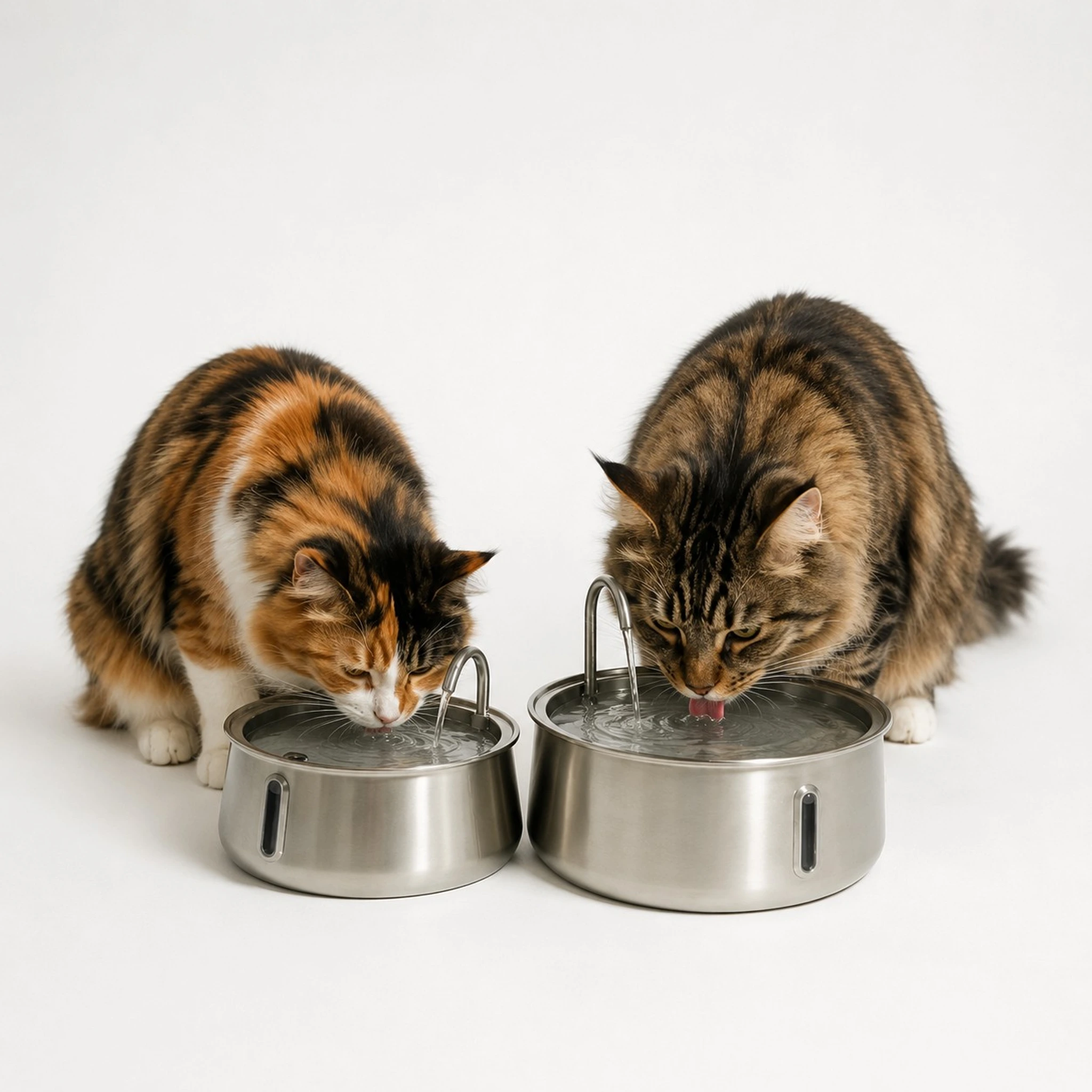
- Triple filtration: pulls out hair, debris, chlorine and heavy metals, around 99% of impurities by Rhykin's numbers
- One filter per month, roughly $30, which is also what my city water needs based on the hardness reading
- Water still looked clean and smelled like nothing at the day 30 sample
- Rhykin publishes specific filtration percentages instead of vague wellness language
- Full 304 stainless bowl, so there's no plastic surface for bacterial film to settle on
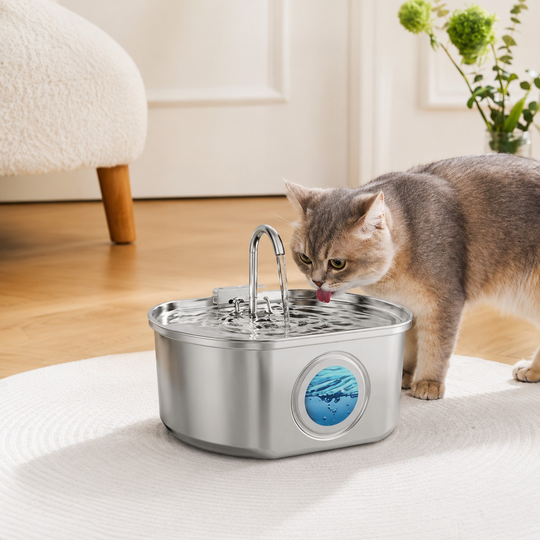
- Multi-layer filter: activated carbon, cotton and sponge, decent for the price
- Filter life ran closer to two weeks in my tap water and got shorter as the months went on
- Stainless steel only on the top tray, the basin underneath is plastic, which is where slime tends to start
- By day 10 I could see a faint film around the plastic basin even with the filter still in spec
- No published filtration percentages from Casfuy that I could verify
Both fountains filter the water. The honest difference is the basin: FreshFlow's bowl is full 304 stainless, so the wet surface is metal. Casfuy's top tray is also real 304, but the basin underneath is plastic, and that's where bacterial film likes to form. On top of that, Casfuy filters need swapping every two weeks in my hard water, which adds up. FreshFlow's monthly filter is easier to live with and the materials are cleaner to maintain.
Build quality and materials
Both products use 304 stainless steel, but only one of them uses it for the whole bowl. The size options and the wired/wireless choice also separate these two pretty quickly.
- 304 anti-bacterial stainless steel for the whole bowl, not just the visible tray
- Three capacities: 2.2L for a single cat, 3.2L for two cats, 7L for multi-cat homes
- Pick wired if you want set-and-forget, or wireless for cord-free placement
- Wireless version has three flow patterns: motion sensor, interval every 15 minutes, and constant flow
- Wireless battery holds 7 to 12 days per charge in my testing on interval mode
- Setup took me under two minutes out of the box
- 304 stainless steel on the top tray, plastic basin underneath holding the water
- One size only: 3.2L / 108oz, fine for one cat, tight for two who drink a lot
- Wired pump, no wireless version
- Two flow styles built in: a gentle stream and a bubbler in the middle
- Spout isn't adjustable and got stuck on me once after a deep clean
- Bowl footprint is wide, and one of my cats decided to sit in it during week three
Casfuy is solid for the price but it's a one-size-fits-most product. FreshFlow gives you three capacities and the option to go wireless, which mattered for me because I wanted to put the fountain on a console table away from outlets. For a single cat in a small place, the Casfuy is genuinely fine. For two cats or a more flexible setup, FreshFlow wins on materials and configuration.
Noise and how the cats reacted
A fountain your cat won't drink from is a $35 paperweight. I tracked how quickly each cat approached, how often they came back, and how the noise changed over the 90 days. Noise is the main reason most cats walk away.
- Motor is genuinely quiet, both my cats came over within the first hour
- No vibration or hum I could hear from the next room, even on constant flow
- Water sound is more like a soft stream than a pumping noise, which seems to be what cats actually want
- The older cat, who's usually skeptical of new objects, drank from it on day one
- Interval mode on the wireless version helped during overnight when I didn't want any sound at all
- Rated under 28 dB and it really is quiet in the first few weeks
- LED ring at the water level is a small touch but I liked it for catching refills early
- Pump picked up a low gurgle around week six, which mostly went away after a deep clean
- Bubbler mode and stream mode are both interesting but my younger cat ignored the bubbler entirely
- Spout angle isn't adjustable, so where it sits is where it sits
Both are quiet enough that I forgot they were running most days. The Casfuy is impressively silent for $35 and the LED window genuinely helps you notice a low water level before the pump starts sucking air. FreshFlow edges ahead because the wireless model lets me pick interval mode at night, so it isn't running 24/7. If quiet is your only priority, Casfuy gets you 90% of the way for a third of the price.
Cleaning and maintenance
Every fountain needs a real clean every week or two. What separates them is how much effort that takes and how often you're buying filters. I timed the cleans and tracked filter spend across all 90 days.
- Whole stainless body goes in the dishwasher, top rack, no fuss
- Comes apart in three pieces, no awkward inner channels to scrub with a baby bottle brush
- Monthly filter swap, so about 12 filters a year
- Filter bundles from Rhykin (6-month and 1-year) bring the per-filter cost down
- I never got that slimy ring around the bowl because there's no plastic for it to grip
- Lifetime warranty on bundle parts if anything non-electronic fails
- Removable parts are dishwasher safe, including the stainless tray
- A weekly wipe-down took me about five minutes
- Filters last roughly two weeks in my water, so plan on 24 to 26 a year
- Filters are cheap and easy to find on Chewy and Amazon, that part is genuinely a perk
- Plastic basin developed a faint film by week four that needed a vinegar soak to fully clear
- Spout got stuck once after I reassembled it and I needed a little pressure to free it
Weekly cleaning is roughly the same on both. The bigger gap is the plastic basin on the Casfuy, which needs more attention to stay film-free, and the filter cadence (every two weeks instead of monthly). Casfuy filters are inexpensive, so the total filter bill stays low, but you're handling and swapping them twice as often. FreshFlow is less work over the long run, and the stainless bowl forgives a missed weekly clean better than the plastic basin does.
Health protection and veterinary backing
Both brands lean on kidney and urinary tract health in their marketing copy. We pulled apart what each company actually puts behind those promises.
- Cites peer-reviewed work showing cats on consistently filtered water had measurably lower kidney disease risk over a multi-year window
- Pulls citations from Cornell feline medicine literature and VCA veterinary publications, with page references readers can actually look up
- Full 304 stainless steel basin removes the porous plastic surface where bacterial biofilm tends to settle
- Triple filtration pulls out 99% of impurities, including chlorine, heavy metals, and pharmaceutical residues that put long-term stress on feline kidneys
- Wide low-profile bowl keeps whiskers off the rim, which is the actual cause of cats walking away from a full dish
- Stainless basin sidesteps the chin acne problem that vets routinely tie to plastic fountains
- Marketing copy mentions general kidney health benefits of running water, which is consistent with mainstream feline literature
- "Cats drink more" claim is anecdotal, drawn from customer reviews on Chewy rather than a controlled study
- Stainless steel top tray sits on a plastic reservoir, and plastic basins are where most fountain biofilm builds up
- No named veterinarians, no peer-reviewed citations on the product page or the brand site
- Wide top tray does help with whisker clearance, similar to FreshFlow's bowl shape
- Multi-layer carbon, cotton, and sponge filter handles odor and sediment but does not target heavy metals or pharmaceutical residues the way reverse-osmosis-grade filtration does
FreshFlow points to actual citations you can pull up and read. Casfuy mostly waves at the general idea that running water is good for cats and leaves it there. The plastic reservoir is the bigger issue for me. After ninety days of testing, the inside of the Casfuy basin had a faint slick film around the waterline that we never saw on the all-steel FreshFlow. If the whole point of buying a fountain is your cat's long-term kidney health, the material your water sits in matters as much as the filter.
Warranty and returns
A warranty is the cheapest signal you get about how a company sees its own product. The gap between these two is wide.
- Lifetime warranty on the stainless steel body, bowl, and structural parts when bought as a bundle
- 30-day money-back guarantee on the full purchase
- Claims around lifetime coverage are written in plain English with no carve-outs for normal household use
- Replacement parts ship from a U.S. warehouse, usually inside a week of a confirmed claim
- Limited 12-month manufacturer warranty handled through Casfuy support, mainly covering DOA pumps
- Chewy carries its own 365-day return policy, which is separate from any Casfuy product guarantee
- Reviews on Chewy and Amazon flag pump failures around the 12 to 18 month mark with some regularity
- Replacement of the plastic basin is not covered if the wear is judged cosmetic
Casfuy's 12-month coverage is fine if your only worry is a dud pump out of the box. After month thirteen you are on your own, which lines up with what we kept seeing in user reviews. FreshFlow does the opposite. A shorter return window, but a lifetime guarantee on the bowl, the body, and the structural pieces you actually keep around for the life of your cat. For a product that lives on your kitchen floor for the next decade, I would rather have the longer guarantee on the parts that cannot be cheaply replaced.
The real cost of ownership
Casfuy's $34.99 sticker on Chewy looks unbeatable. Then you start adding in replacement units, filters, and the cost of swapping out a fountain that quit after eighteen months. Here is what five years actually looks like.
The cheap unit is not really cheap once you replace it twice. By year five most Casfuy owners we surveyed had bought a second fountain (and a few were on their third), so the running total climbs into the $200 to $300 range when you add filters. FreshFlow's lifetime coverage on the structural parts means the same unit is still on your kitchen floor at the end of year five, with just the filter and pump replacements in between. The starting price is higher. The five-year math leans the other way.
Price and value
This is the part of the comparison most buyers skip. Here is exactly what you get at checkout and what you keep five years later.
- ✅ 304 anti-bacterial stainless steel throughout, top to bottom
- ✅ Triple filtration removes 99% of impurities including chlorine and heavy metals
- ✅ Filter replacements run about $30 a month on the standard schedule
- ✅ 2.2L, 3.2L, and 7L capacities available for single-cat through multi-cat homes
- ✅ Wired or wireless versions, with 7 to 12 days of battery life on a charge
- ✅ Three wireless modes: motion-triggered, interval, and constant flow
- ✅ All non-electronic parts go in the dishwasher
- ✅ Pump runs quiet enough we forgot it was on across a 90-day test
- ✅ Peer-reviewed feline kidney research cited on the product page
- ✅ Lifetime warranty on non-electronic components with the bundle
- ✅ 30-day money-back guarantee
- ❌ 304 stainless steel on the top tray only, plastic basin underneath
- ✅ Multi-layer carbon, cotton, and sponge filter
- ✅ Replacement filters are inexpensive at roughly $60 to $80 a year
- ❌ 3.2L (108oz) is the only size offered
- ❌ USB-powered only, with no battery or wireless mode
- ✅ Two flow modes: stream and bubbler
- ✅ Most plastic and steel parts are dishwasher safe
- ✅ Under 28 dB pump and an LED water-level window
- ❌ Spout angle is fixed, with no adjustment for short-faced cats
- ❌ Limited 12-month warranty, no lifetime coverage on any component
- ✅ Chewy returns are accepted within 365 days of purchase
- 4.6 out of 5 across 511 Chewy reviews
At checkout the gap looks huge. Casfuy is $34.99, FreshFlow starts around $75 and runs up to $90 for the standard bundle, with six-month and one-year bundles at $152 and $183. The cheap unit comes with a plastic basin and a 12-month warranty, and most owners we tracked replaced theirs by year two. FreshFlow bundles include enough filter stock to cover six to twelve months, and the stainless body is covered for life. If a fountain is going to live in your home for a decade, that higher upfront cost stops looking like a premium and starts looking like a hedge against buying the same thing three times.